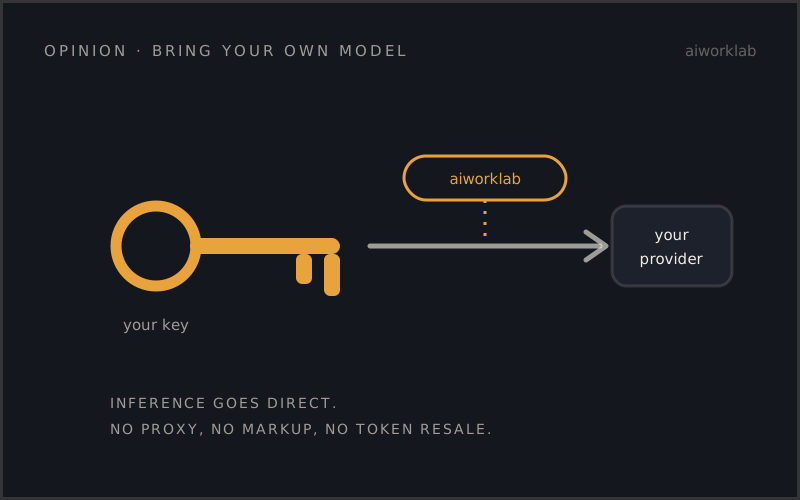
The most common piece of feedback we get on our pricing page is some version of: "BYO-model is fine for a beta, but you'll obviously add hosted inference once you raise more money. Everyone does." It's said kindly, as advice. We want to put on the record, in public, while we're small enough that nobody can accuse us of rewriting history later: no. Bring-your-own-model is the permanent shape of this company, and the reasons are structural rather than budgetary.
The reseller's dilemma
Start with how most AI coding tools make money. They buy inference wholesale from a model provider, mark it up, and sell it to you bundled into a subscription. The economics only work if usage stays inside a band: enough that you renew, not so much that your tokens eat the margin.
That model creates a quiet, permanent conflict between the vendor and the user, and it pulls in a specific direction. Every product decision that increases token consumption (longer agent runs, more speculative edits, "let me just refactor this whole file for you") is revenue-positive for the vendor right up to the margin ceiling. Every product decision that decreases token consumption is revenue-negative. Guess which kind of decision wins more roadmap debates over five years.
Now look at what aiworklab is for. Our entire thesis is that engineers should need the agent less over time: that mastered concepts should pass through without ceremony, that solo capability should trend upward, that the product should get out of your way as you grow. A teaching layer that works is, mechanically, a token-consumption-reduction machine. A company whose margin is a percentage of token consumption cannot build that product honestly. The incentive gradient runs through every PM, every quarterly review, every pricing experiment, and it runs the wrong way.
You cannot sell tokens by the pound and also sincerely teach people to need fewer of them. Eventually the business model wins the argument.
The failure modes of reselling, from the user's chair
The conflict isn't abstract. It shows up as concrete product behaviour you've probably already experienced somewhere:
Opaque routing. When the vendor controls inference, you don't actually know which model answered you. Quietly routing "easy" requests to a cheaper model is the single most obvious margin lever in the industry, and as a user you find out only when quality dips and nobody can tell you why.
Rate limits as a pricing instrument. Usage caps, throttling, "fair use" policies that tighten after you've committed. None of this exists because of physics; it exists because your usage is the vendor's cost.
Repricing risk. When the provider's wholesale price moves, the reseller's retail price follows, on the reseller's schedule, with your workflow held hostage in the middle.
Lock-in by bundle. If switching tools means losing your inference deal, the tool is no longer competing on being a good tool.
Under BYO, every one of these dissolves. You know exactly which model runs because you chose it. Your rate limits are whatever your provider contract says. Price changes are between you and your provider, negotiated with the full leverage of a direct customer. And you can leave us any day without your inference setup noticing, which means we have to keep earning the subscription on the merits of the teaching layer alone. We consider that pressure a feature of our own incentive design.
What flat pricing aligns
aiworklab charges a flat amount: $19 a month for Pro, $39 a seat for Team, a contract for Enterprise. We never see your token bill and never touch your inference traffic. Three alignments fall out of that, and they're the ones we actually care about:
Friction stays honest. When an explain-to-merge check or a fly-solo session reduces your agent usage, it costs us nothing. We can put friction exactly where the pedagogy says it belongs, with no finance team in the room.
Local models are first-class, not grudging. A reseller supporting Ollama is cannibalising itself, so local support stays perpetually half-finished. For us, a user on a local model is identical to a user on a frontier API: same subscription, same product. That's also the only honest path for regulated industries and air-gapped environments, which is where the skill-atrophy problem is often most acute.
Our revenue tracks the thing we claim to deliver. We grow by seats and by tiers, which means we grow by being worth $19 to an individual and worth a dashboard to an org. If the teaching layer stops earning that, we deserve to shrink. There's no token stream to hide behind.
The objections, taken seriously
"BYO is too much setup friction. You're capping your own market." This was true in 2023. In 2026 the two easiest paths are a one-click OAuth sign-in with the Anthropic or OpenAI account a developer already has, or auto-detection of a local model already running on their laptop. Most private beta users were issuing their first agent run in under a minute. The residual friction is real but small, and shrinking every quarter, and we'd rather absorb it than absorb the conflict.
"You're leaving money on the table." Yes. Deliberately. Token margin is the table. The whole argument of this post is that the money on that particular table is paid for with product integrity, and the exchange rate is terrible for a company whose product is trust in its own measurements.
"Enterprises want one vendor and one invoice." Some do, and for them the answer is the org gateway: their admin points aiworklab at the LiteLLM, Bedrock, or Vertex endpoint they already operate, the team signs in through SSO, and procurement still has exactly one inference contract, theirs, on their terms. What enterprises want even more than one invoice is knowing where their code goes. "Your code goes to the provider you chose, and never through us" is the shortest security-review answer in the category.
"What if a model provider builds your features?" Then the teaching layer has to be good enough to win anyway, on any model, which is the discipline BYO imposes on us daily. A provider-built teaching layer will always be tuned to sell that provider's tokens. Ours can't be, structurally. We think that difference is legible to engineers, who are the most incentive-literate customers in software.
Holding it permanent
Stances are cheap when they're convenient, so here is the test we invite anyone to hold us to: aiworklab will never proxy, meter, resell, or mark up inference traffic, and the day any pricing page of ours quotes a price per token is the day this post should be thrown back at us, loudly. We've written the same commitment into the pricing page and into how we talk to investors.
The companies that sell you tokens need you to keep needing them. We'd rather be the company you keep choosing after you don't. If you think there's a hole in this reasoning, we genuinely want to hear it: team@aiworklab.com.